Recently I finished reading John Philip Newell’s book, Sacred Earth, Sacred Soul. Newell digs into Celtic history and illuminates an amazing group of Celtic writers, poets, activists, saints, and naturalists who have contributed to an understanding of Celtic Christianity. Adapted from some of the life-giving rituals of pre-Christian pagan culture, Celtic Christian theology holds that matter and spirit are interconnected and thus offer us a model of how we can be and live in the physical world and with each other. In other words, how we treat the Earth and each other flows and determines the spiritual path we are on: one that is lifegiving, indifferent, or destructive. This lifegiving theology — that matter and spirit are intertwined — is critical to our world today because it can shape how we see God, Spirit or the Divine (and how we believe that God, Spirit or the Divine sees us), even if we are not religious.
When I’m in nature, I find myself more easily yielding to the God of my understanding. I receive instructions and wisdom for my life as I gaze on landscapes, trees, sky and critters. I’m astounded by what God shows me in these moments.
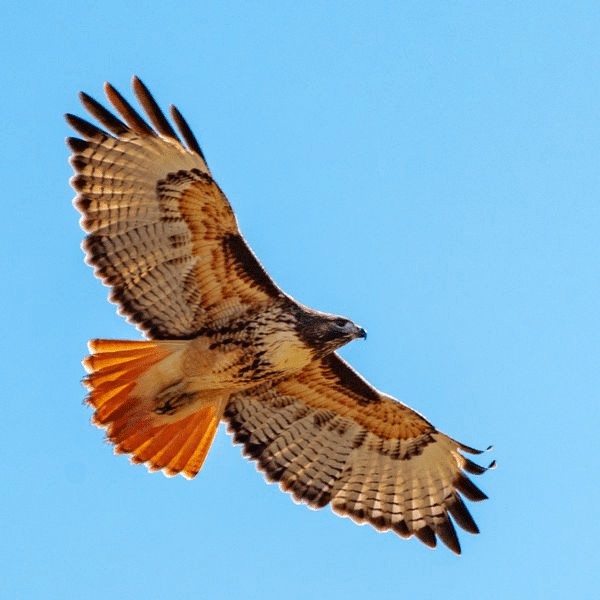
I have found that nature is always reflecting back to me who I am.
During a time of silence at my favorite retreat house a decade ago, the following insights arrived even before I unpacked my bags and watched a hawk with wonder from my bedroom window:
“I go to my room and open the large window overlooking the west lawn. A red-tailed hawk quickly catches my eye as she soars close to the building in the billowing airwaves that rattle through clumps of leaves on the age-old oaks. The hawk was totally playing, I could tell. She wasn’t looking for food or anything, just enjoying the ride: letting go and doing what she’s made to do – enjoying the currents that God had supplied for her amazing wings! I wonder: why don’t I do this more? Why don’t I let go and let the flow of my God-given life and gifts move me naturally, like the wind lifts the hawk without any effort on her part — except to spread her wings and be willing to go up! In that moment, I decided that I want to trust God and life more, like Red-tail trusts her wings and the wind!”
From watching Red-tail, I was suddenly faced with the relationship between trust and freedom: trusting that my aliveness had purpose and that my purpose could only be found and lived if I was in a state of spiritual freedom.
A more recent time in my life is illustrated in the following allegory that I wrote when I was contemplating “what was next” while spending time at a favorite local park:
“Four Canada geese stand at the helm of a waterfall in Monocacy Park where I often go to be, to pray, and to reflect. I am sitting on their level in a stone pavilion, off to the side. The senior goose walks along the slanted, slippery grade to the edge of the falls, about 12-foot high. She announces her intention in loud bouts of honking and easily flies over the falls and into the white frothing stream below. Soon after, two of her sister geese follow … but a third holds back.
This lone lady bird walks tentatively along the slanted upper precipice, as if not sure she should follow her sisters. Looking around, she eventually begins to honk — anxiety and courage like two strong wings rising inside her. Upon reaching the waterfall’s edge, she steps back. In the next moment she moves again to the edge and stretches out her long neck, only to pull back again. I watch her for four or five more minutes with amazement. By now I notice the other three geese are downstream and out of sight.
I continue to watch as she struggles to let go. Several times she moves back and forth along the slippery concrete slab and gushing water. Then, as my own mind drifts quietly, she spreads her wings and sails downward over the falls, landing in the rapids and bobbing downstream between a few boulders, eventually out of sight.
I wondered: “Where will the stream take her?”
At the time I wrote “The Monocacy Geese,” I was in a period of some tension as I sought to find new direction in my life. In retrospect, rereading the Monocacy Geese allegory reveals something new. As I watched this ambivalent bird finally summon the courage to fly over the dam – as I hoped she would eventually – I now see that I eventually gave myself permission to follow the guidance that was coming to me regarding my own writing and the eventual publication of my book, Journaling as a Spiritual Path.
When I allow myself to spend time in nature, I can become truly one with the Spirit and one with myself. This is a gift of wholeness: my recognition that I am as much a part of nature as nature is deeply part of me. When I journal what I notice in nature, I take in the wisdom that is being mirrored to me, as nature is always reflecting back to me who I am. This produces spiritual growth in my life, a breakthrough in how I see the divine, myself and the world. These two spiritual practices of spending time journaling and spending time in nature can truly transform me.
Questions for Journaling: What are your favorite local landscapes? What spiritual qualities do they have? Can you spend time there and see what Nature and Spirit want to show you about yourself?
 Journaling as a Spiritual Path
What a beautifully written spiritual experience. I felt as though I were there with you. Thank you ! Sue
LikeLike
Sorry for the late reply, but Thank you!
LikeLike